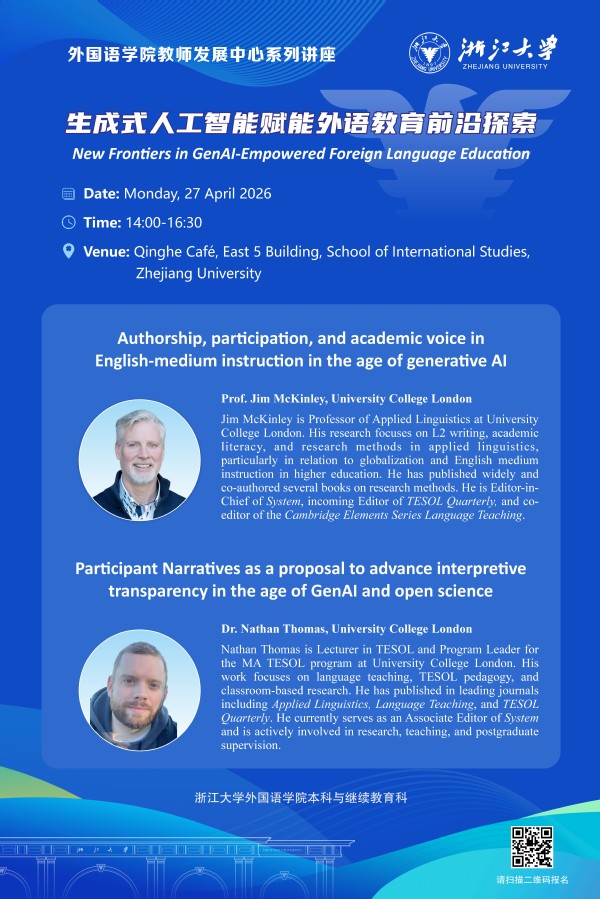

New Frontiers in GenAI-Empowered Foreign Language Education
生成式人工智能赋能外语教育前沿探索
Date: Monday, 27 April 2026
Time: 14:00-16:30
Venue: Qinghe Café, East 5 Building, School of International Studies, Zhejiang University
Time | Session | Speaker(s) | Title |
14:00-14:10 | Opening and Welcome | ||
14:10-15:00 | Keynote 1 | Jim McKinley (UCL) |
|
15:00-15:50 | Keynote 2 | Nathan Thomas (UCL) |
|
15:50-16:30 | Discussion and Communication | ||
Title: Authorship, participation, and academic voice in English-medium instruction in the age of generative AI
Prof. Jim McKinley, University College London

Jim McKinley is Professor of Applied Linguistics at University College London. His research focuses on L2 writing, academic literacy, and research methods in applied linguistics, particularly in relation to globalization and English medium instruction in higher education. He has published widely and co-authored several books on research methods. He is Editor-in-Chief of System, incoming Editor of TESOL Quarterly, and co-editor of the Cambridge Elements Series Language Teaching.
Abstract: Generative AI is rapidly reshaping academic communication, yet discussions in English-medium instruction (EMI) have largely focused on academic integrity and assessment security. This talk argues that generative AI instead challenges more fundamental assumptions about participation, authorship, and linguistic competence that underpin EMI policy and practice. Drawing on recent work on writer identity alongside classroom-based reflections from EMI teaching contexts, I examine a growing pedagogical paradox: while AI tools appear to lower linguistic barriers to academic production, student participation in classroom discussion and collaborative meaning-making may be changing in unexpected ways. Instructors increasingly observe students turning to AI-mediated support during learning activities, raising questions about how engagement, intellectual struggle, and disciplinary socialisation are being reconfigured. I suggest that these developments expose longstanding tensions within EMI, where participation has often been equated with visible linguistic performance in English. Rather than framing AI as either threat or solution, the talk considers how EMI policy and pedagogy might reconceptualise participation and authorship in contexts where academic work is becoming a hybrid human–AI practice.
Title: Participant Narratives as a proposal to advance interpretive transparency in the age of GenAI and open science
Dr. Nathan Thomas, University College London

Nathan Thomas is Lecturer in TESOL and Program Leader for the MA TESOL program at University College London . His work focuses on language teaching, TESOL pedagogy, and classroom-based research. He has published in leading journals including Applied Linguistics, Language Teaching, and TESOL Quarterly. He currently serves as an Associate Editor of System and is actively involved in research, teaching, and postgraduate supervision.
Abstract: There are several key negotiations that often take place in EMI research: policy vs practice, outcomes vs experience, and, recently, tradition vs modernity in the way GenAI is incorporated, or not, in research and practice. We can also witness similar negotiations in current discussions of open science (a “modern” phenomenon) in relation to qualitative research, which has rich traditions. Fundamentally, is “modern” always preferential in relation to tradition? At what point does something modern become tradition? And is there a risk that practices associated with modernity or tradition become dogma? In thinking through some of these issues, I propose a research practice that appears anti-modern as a possible solution for the very modern dilemma qualitative researchers face in relation to open science: how can we become more “open” in our interpretive research practices? Participant Narratives are researcher-configured texts that re-present interview data as coherent, contextualized narratives. They invite readers to engage directly with interpreted material, provide a fuller context than isolated excerpts, and offer a feasible alternative to accessible transcripts. Importantly, these narratives steer toward methodological rigor and ethical responsibility, without yielding to “modern” encroachment on the ethos of qualitative research. I demonstrate how they can be used by researchers interested in narrating the lived experience of EMI and other topical domains.