
On the afternoon of September 26, 2025, at the invitation of the Institute of German Studies, Zhejiang University, Ingo Schulze, a renowned German writer and President of the German Academy for Language and Literature (Deutsche Akademie für Sprache und Dichtung), visited Zijingang Campus and gave a reading session from his popular novel Die rechtschaffenen Mörder at Lizhou Hall of Qizhen Hotel for Zhejiang University students and teachers. This was the 35th event in the Dong’s Academic Salon of Literature, History and Philosophy series “History of Sino‑German Literary Exchanges”, organized by the Institute of German Studies. The session was moderated and translated by Dr. Weijie Ring Zhao, a specially appointed associate researcher at the Institute. About 60 students and teachers from Zhejiang University and Zhejiang University of Science and Technology were present. Professor Dr. Jutta Müller‑Tamm, Chair of Department of German and Director of Friedrich Schlegel Graduate School of Literary Studies at Free University of Berlin, was also present as a guest.
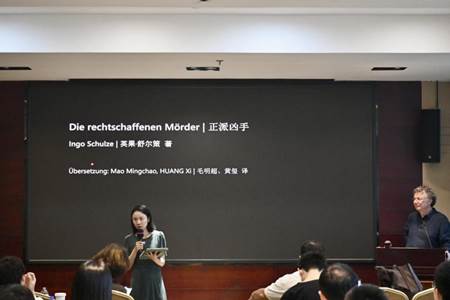
Photo: Associate Researcher Weijie Ring ZHAO (Institute of German Studies) moderating the reading session
At the start, Dr. ZHAO introduced Schulze’s literary background and achievements to the attendees. She noted that Schulze is not an author isolated at his desk but a writer closely engaged with readers, and he attaches great importance to the social responsibility of the writer as a public figure, which was one reason he was elected President of German Academy for Language and Literature. The work Schulze shared was his 2020 novel Die rechtschaffenen Mörder, published by S. Fischer. The novel is divided into three parts and Schulze selected passages from each part for reading.
Schulze began with an epigraph quoted at the beginning of the novel and said “Who can guess how a book will end?” Later, he read the first excerpt with expressive modulation. The attendees followed the translated text displayed on the screen and was drawn into the work by the author’s nuanced delivery.
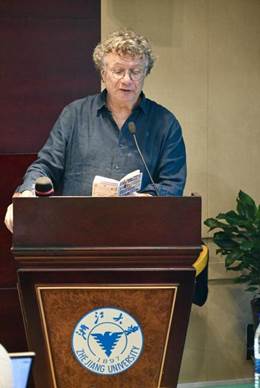
Photo: Ingo Schulze reading an excerpt from Die rechtschaffenen Mörder
The protagonist Paulini is a well‑respected antiquarian bookseller in Dresden. In his bookstore, book lovers can find literary treasures and encounter like‑minded people. For over forty years, he has experienced personal and social ups and downs. Even as the times changed and online shopping became a rival that left the bookstore nearly empty, he tries to hold on to his convictions. Yet Paulini’s temperament has turned irritable and uncompromising, and he is accused of being involved in xenophobic riots. The reversal of his role, from a respectable collector to an “reactionary” figure, leaves ample room for reader reflection. The novel’s shifting narrative tones, stylistically diverse chapters, and the multi-faceted, complex portrayal of its protagonist are striking. What at first appears to be a chronicle of a Dresden bookseller gradually transforms into a dramatic love story, a reflection on the autumn of 1989, an analysis of the psyche and memories of the people from East Germany and ultimately an indictment of the unease of our own age.
The attendees gave a warm round of applause for his reading. Dr. ZHAO noted that the novel’s multiple narrators (the bookseller, a novelist, an editor) all have an intimate connection with books, which is particularly interesting. She added that the sudden death of a character at the novel’s close and the occurrence of German reunification both feel like an attractive Schicksalsschlag.
During the Q&A, Dr. ZHAO first asked about the multiple narrative perspectives of the novel and how they interpret the characters differently. Schulze replied that discussing multi‑perspective readings requires an analysis of the book structure. In Part I, the bookseller Paulini appears as a character in the novel. Part II is narrated in the first person by a novelist who describes the “friend Paulini”. Part III is told in the first person by an editor who relates what he knows of Paulini and what he sees of him in the novelist’s book. Through this triple perspective, Schulze is able to construct a rich character for Paulini.
Professor LIU Yongqiang was also interested in the novel’s multiple narrative viewpoints. He compared them to Russian nesting dolls and asked whether Schulze’s experiences in Russia had influenced his narrative design, and how he linked and balanced these perspectives in his writing. Schulze replied humorously that his work was not inspired by Russian dolls. In the planning stage he clarified his ideas by using interrogative prompts. For example, “Who will be the appropriate narrator?” and “Why would this narrator tell the story?”. In theory, narrative viewpoints could be nested endlessly like matryoshkas, but he felt the three perspectives in this novel were sufficient to build a rich character.
SUN Yiyang, an undergraduate majoring in German, drew on her visit to the Berlin Wall site and her reading experiences to raise a question, “What moves readers more, the novel’s content or its technique?” Schulze replied that the answer depends on each reader, since reading experiences are unique. He added that a novel’s distinctive power lies not only in resonating with readers and using fiction to reveal significant meanings in real life, but also in offering readers an apprehension of vast historical processes through a microscopic, individual perspective: an emotional reach that many historical non‑fiction works cannot achieve.
QU Yujing, another 2022 undergraduate of German major, was especially interested in how the author shapes character’s personalities during writing and asked whether characters ever deviate from their original designs as the plot develops. Schulze explained that he sketched characters in advance, then refined them through their words and actions in concrete scenes. Crucially, the author shall maintain a creator’s self‑distancing, i.e., separating oneself from the characters, in order to authentically instill personalities into them.
Another student LI Yifei asked about Schulze’s life as a writer, such as income sources and how he balances work and life. Schulze generously shared his views: his ideal work routine is a regular nine‑to‑five writing schedule (with a midday nap), though he acknowledged this is rarely realized. He noted the greatest difficulty in writing is the beginning of a work, and that the start of a literary career is likewise important. He considers himself fortunate that his debut was an immediate success, so he never had to “write while driving a taxi”. Regarding income, he said some UK universities offer professorships in creative writing that provide financial support, yet a practice less common in German‑speaking countries. In Germany, even successful authors typically receive only about 10% of sales revenues from book sales, so they mostly earn income from readings and public presences, plus occasional prizes, though winning such prizes is like playing the lottery. The attendees laughed.
Another student CHU Tianyu asked for Schulze’s advice to contemporary writers in light of AI’s impact on literary creation. Schulze acknowledged AI’s impact but urged writers not to abandon writing out of concern. Creators should seek, through practice and reflection, the irreplaceability of their linguistic features and intellectual depth. He situated this in a broader literary‑historical perspective: themes like “death” and “love” recur across eras, yet the writers and readers of each generation approach them distinctively. He concluded by wishing CHU “Viel Glück!”
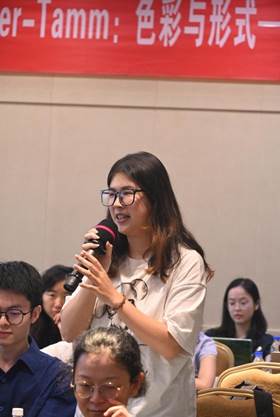
Photo: SUN Yiyang (German major, class of 2022) asking a question
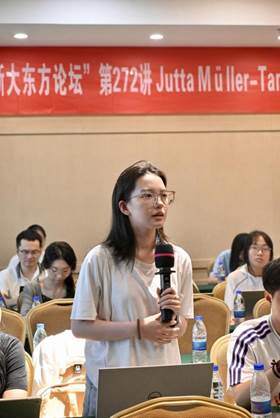
Photo: QU Yujing (German major, class of 2022) asking a question
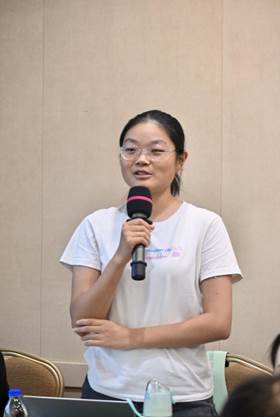
Photo: LI Yifei (German major, class of 2022) asking a question
At the end, moderator Dr. ZHAO delivered a brief summary to appreciate all the attendees for their enthusiastic engagement and profound dialogues, and the reading concluded in warm applause. The session full of sincere warmth and rigorous discussion offers Zhejiang University students and teachers a high‑quality opportunity to experience German literature up close and converse with a leading international writer, and energizes Sino‑German literary and intellectual exchanges through interactive dialogues.
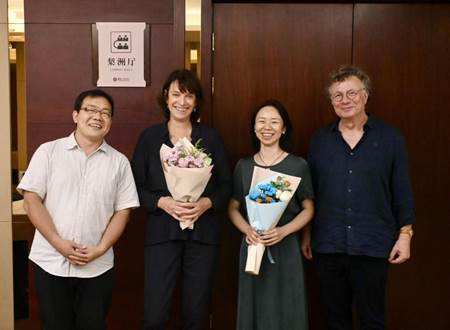
Photo: Moderator with the guests
Text: JIANG Zunlong
Photo: CHU Tianyu
Translated by WANG Jingyun, proofread by XU Xueying

