
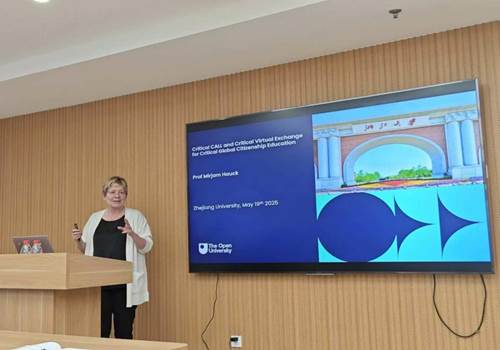
On the morning of May 19, 2025, the 97th Session of Zijin Lectures organized by the School of International Studies, Zhejiang University, was held as scheduled at Qinghe Cafe of East 5 Building. The lecture “Critical CALL and Critical Virtual Exchange for Critical Global Citizenship Education” was delivered by Professor Mirjam Hauck from the Open University (UK), and moderated by Associate Professor LUO Rong of the School of International Studies.
Prof. Mirjam began by introducing the core concept of Virtual Exchange, i.e., using digital technologies to connect students from different countries and cultural backgrounds, and cultivate intercultural communication skills, digital literacies, and global citizenship through collaborative projects. She noted, however, that Virtual Exchange is not inherently fair. In practice, it is constrained by English hegemony, disparities in technology access, and insufficient institutional support, all of which can exacerbate educational inequality. For example, indigenous Global South knowledge is often excluded from AI training data, which may lead to cognitive injustice in the contents generated by large language models.
In response to these challenges, Professor Mirjam proposed Critical Virtual Exchange (CVE) framework and summarized its five pillars: 1. Low-bandwidth technologies: using basic videoconferencing and similar tools to ensure access for all participants. 2. Localized globalization: including students from low socioeconomic backgrounds to fill in equity gaps left by traditional study-abroad models. 3. Alignment with the Sustainable Development Goals (SDGs): linking projects to global issues to increase practical relevance. 4. Public engagement: encouraging students to collaborate with local NGOs and bring local experience into international dialogue. 5. Translanguaging: using AI translation and related tools to construct a “third-language space” to shatter English monopoly and enhance linguistic diversity and collaborative fairness.
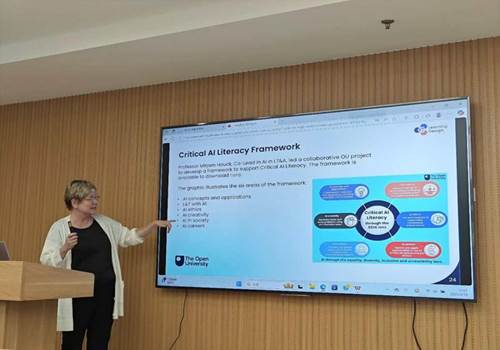
Prof. Mirjam then presented the Critical AI Literacy Framework developed by her team. The framework is organized in six key dimensions: foundational knowledge of AI and common applications, AI tools in teaching and their efficacy assessment, algorithmic bias and ethical issues, creative expression in human-AI collaboration, AI’s impact on social structures and cultural power, and adaptability and decision-making with AI tools in future professional contexts. The framework highlights, by designing better prompts, guiding AI towards more inclusive outputs and training users to identify knowledge gaps in training data, thereby fundamentally improving the diversity and fairness of AI.
In the second half of the lecture, Prof. Mirjam shared several teaching cases that of integrating CVE theory. For example, in a project on urban sustainability, students from Argentina, Poland, and Sweden jointly analyzed the official images and underlying challenges of their respective cities and revealed social inequalities embedded in urban planning by comparing government promotions with street photography. Citing a study from King’s College London on the sense of belonging of East Asian students, she illustrated that CVE can serve as a pre‑departure intervention to facilitate cross‑cultural connections, alleviate adaptation anxiety for students before their studying abroad, so as to enhance inclusive experiences in new environments.
In closing, Prof. Mirjam emphasized that CVE should not be treated as an extracurricular add‑on but a core educational strategy. As a scalable path toward localized critical internationalization and global citizenship education, CVE can shift practice from a “safe, hegemonic” model of virtual exchange to a “brave, decentered” mode of critical collaboration. This shift can bring profound impacts at individual, institutional, and policy levels and holds potential to catalyze transformations both locally and globally.
The rich lecture with vivid cases and active interaction stimulated in‑depth reflection among students and teachers on the theory and practice of Critical Virtual Exchange. They all reported substantial gains as they acquired not only a comprehensive and nuanced understanding of the educational potential of VE, but also fresh ideas for building more inclusive and socially responsible pedagogies in local educational contexts.
Photos, Text: LI Chengxin
Reviewed by: LUO Rong, SUN Peijian
Organizer: Zijin Club
May 19, 2019
Translated by WANG Jingyun, proofread by XU Xueying

