

On the afternoon of December 1, 2025, Professor Antony John Kunnan, a renowned global language assessment expert, was invited to deliver an academic lecture titled “AI in Language Teaching, Learning, and Assessment: Snake Oil or Panacea?” at the School of International Studies, Zhejiang University. The lecture was moderated by Professor HE Lianzhen, with active participation from students and teachers in related disciplines.


Beginning with the metaphors of “snake oil” and “panacea”, Professor Kunnan highlighted the divergent views on artificial intelligence in the fields of teaching and assessment. Some argue its effectiveness is overstated, while others regard it as a key driver of transformation. Against this backdrop, he raised a central question: Will AI bring about positive impacts, much like technologies such as the telephone, the internet, and smartphones, or will large language models (LLMs), due to their training and application mechanisms, alter human language interaction and give rise to new inequalities and risks.
After outlining the major debates, Professor Kunnan distinguished between generative AI and predictive AI. He noted that generative AI, which relies on LLMs, can be used for tasks such as designing test items and generating texts, while predictive AI, which forecasts outcomes based on historical data, is often employed in admission and recommendation systems related to examinations and employment. While the former holds potential in educational assistance, the latter, when applied to high-stakes decision-making, requires careful attention to its potential biases and inequities.
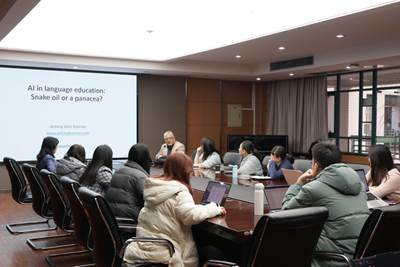
Furthermore, Professor Kunnan provided a detailed overview of the latest research advancements in adaptive learning systems, corpus linguistics, and natural language processing. In the realm of language assessment, he focused on the application of LLMs and automatic speech recognition (ASR) in automated scoring. He emphasized that while automated scoring can provide real-time feedback, it still faces challenges such as limited transparency and high error rates, so it still fails to replace human scoring in high-stakes assessments.
During the Q&A session, students and teachers engaged in discussions on topics such as “how to prevent students from over-relying on AI” and “the potential impact of AI scoring on writing styles”. Professor Kunnan pointed out that over-reliance on AI could undermine students’ capacity for deep learning and emphasized the need to guide students in comparing, reflecting, and using AI critically. He also cautioned that if scoring algorithms lack transparency, students may sacrifice creativity in language expression to cater to AI, which could hinder the long-term development of writing skills.
In conclusion, Professor Kunnan emphasized that AI is neither a fraudulent “snake oil” nor a cure-all “panacea”. He called for the fields of language teaching and assessment to embrace technology while strengthening efforts in bias mitigation, transparency mechanisms, and safety regulations, ensuring that the application of AI remains grounded in educational value and professional judgment.
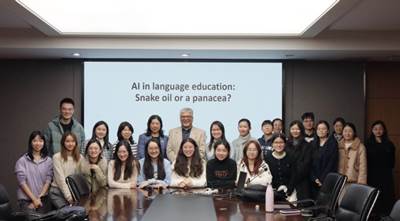
Rich in content and broad in perspective, this lecture provided significant insights for students and teachers to deepen their understanding of the opportunities and challenges presented by AI technology in language education and assessment.
Text and Photos: ZHANG Yang and SHI Lin
Institute of Foreign Linguistics and Applied Linguistics, Zhejiang University
Research Center for Language Development and Assessment, Zhejiang University
Translated by YU Jinbo, Proofread by XU Xueying

