
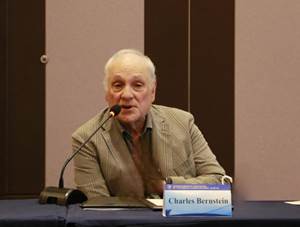
From June 10 to 12, 2025, Charles Bernstein, Professor at University of Pennsylvania, Fellow of American Academy of Arts and Sciences, and Guggenheim Fellow, visited Zhejiang University at the invitation of the Global Lecture Series as the guest of its 181st event.
As a leading figure and theorist of American Language Poetry, Prof. Bernstein is co‑founder and former editor of L=A=N=G=U=A=G=E, a journal on poetry. He has published more than 40 books, including collections of poetry, essays, and plays. Major works include Attack of the Difficult Poems, Girly Man, and Republics of Reality. His honors include the SUNY Distinguished Professor Award, the Münster International Poetry Prize, the Janus Pannonius Poetry Prize, the Bollingen Prize for Poetry (lifetime achievement), a Guggenheim Fellowship, and NEA Creative Writing Fellowships.
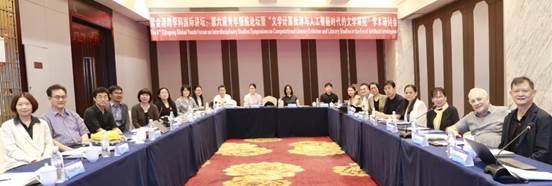
On June 11, the 6th Zijingang Global Youth Forum on Interdisciplinary Studies Symposium on Computational Literary Criticism and Literary Studies in the Era of Artificial Intelligence was successfully held at Zhejiang University. It was co‑hosted by Institute for Interdisciplinary Study of World Literature and Institute of Foreign Literature of Zhejiang University. Scholars from China, the United States, South Korea, and the Philippines engaged in in‑depth exchanges on interdisciplinary research approaches, the integration of technology and the humanities, applications of AI in literary creation and analysis, and innovations in computational literary criticism methods. Prof. Bernstein delivered a plenary titled “Poetry Has No Future Unless It Comes to an End: Intelligent Artifice and the Poetics of Artificial Intelligences”, sharing practical experience in training models to generate poetry collections under AI creative paradigms. He noted that although AI‑generated poetry differs from human composition in affective expression, its distinctive linguistic structures can nonetheless effectively evoke reader resonance. Prof. Bernstein also analyzed the relationship between technology and art and argued prospectively that AI will not replace traditional writing but will expand the full domain of literary creation; for example, in enabling rhythms, cadences, and structures that traditional poetry finds difficult to achieve. On authorship, he offered a profound insight: AI poems should be regarded as “my work”, as humans inject substantial intent and design in data training, text selection, and editing, so humans and AI are joint agents of creation.

On the morning of June 12, Professor Bernstein visited Institute for Interdisciplinary Study of World Literature and the editorial offices of Journal of Interdisciplinary Studies of Literature (A&HCI) and Forum for World Literature Studies (ESCI) at Zhejiang University. Professor YANG Gexin, director of the Center, and his research team engaged Prof. Bernstein in substantive academic dialogue. The parties conducted wide‑ranging and productive discussions on future directions for cross‑cultural research and potential journal collaborations. Their dialogue will be inspiring in the field of world literature studies.
During the discussion, Professor YANG Gexin provided a detailed account of the history and development goals of Zhejiang University’s Institute for Interdisciplinary Study of World Literature. Since its official establishment on December 15, 2017, the Center has been dedicated to building a world‑class discipline in foreign languages and literatures, guided by principles of social responsibility, scholarly innovation, national consciousness, and first‑rate results. The Center is developing on two academic journals, A&HCI‑indexed Journal of Interdisciplinary Studies of Literature and ESCI‑indexed Forum for World Literature Studies, as well as The International Association for Ethical Literary Criticism. By breaking down disciplinary and professional barriers, it aims to construct an innovative platform that spans institutions, disciplines, and countries for international and interdisciplinary cooperation in world literature, so as to ensure our research has high starting points, superior quality, and ambitious goals.
Prof. Bernstein highly praised the Institute’s notable achievements across multiple academic fields and fully affirmed its efforts to promote interdisciplinary and cross‑cultural academic collaboration. He noted that with the rapid development of globalization and technology, interdisciplinary and cross‑cultural cooperation will become an important driver of progress in world literature research and theory. Both parties agreed to deepen cooperation, explore more collaborative opportunities, and promote broad intellectual exchanges, with a common goal of sharing outcomes within the academic community to energize innovation and development in world literature studies. This partnership is certain to have a far‑reaching impact in international academic arena and to stimulate growth in cross‑cultural literary research.
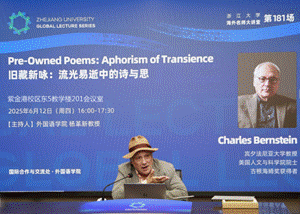
On the afternoon of June 12, the 181st Global Lecturers Series, delivered by Professor Charles Bernstein, was successfully held at School of International Studies on Zijingang campus. The moderator of the lecture was Professor YANG Gexin, director of the Institute for Interdisciplinary Study of World Literature. Those present at the lecture included Professor FANG Fan, Associate Professors SUN Yanping and SU Chen, ZJU 100 Young Professor Will Greenshields, Distinguished Associate Researcher REN Jie, and undergraduate, master’s, and doctoral students.
In his lecture “Pre‑Owned Poems: Aphorism of Transience”, Prof. Bernstein explored the nature and practice of poetry through analyses of writers such as Leonard Cohen, Caroline Bergvall, and Marcel Proust. He argued that formal elements of poetry (such as line breaks and rhythms) are not only visualization of thought but extensions of content. Poetry, he said, functions as a negative intensification of social reality. Excellent poetry should act as a force opposing dominant cognition, affirming poetry’s original status as a “first language” rather than a “second language”. In terms of creation, Bernstein advocated for exploring the unknown and emphasizing gaps and imaginative space in composition, and introduced innovative terms such as “com(op)positionality” and “echopoetics”, asserting that poetry ought to be open and nonlinear.
On sociocultural critique, Bernstein exposed how mechanisms of literary and artistic criticism have been reduced to instruments of commerce and power, and criticized humanities practices that superficially deconstruct hierarchies while reinforcing epistemic dominance. Using the example of “a Jewish museum without Jewish artists”, he condemned cultural institutions’ stripping of identity markers and urged poetry to construct oppositional discourses that dismantle disciplinary mainstream norms. On religion and identity, Bernstein offered the paradoxical statement that “I do not write Jewish, but Jewish writes me”, revealing the internalized paradox of cultural identity and stressing that poetry should break religious constraints on identity and reject absolutist causal narratives. He also engaged with Chinese Chan (Zen) thought with the dialectic of emptiness and fullness as a metaphor for poetic innovation that disrupts traditional cognition. From a philosophical perspective, Bernstein examined multiple dimensions of temporality and cognition. Citing the works of Marcel Proust, he endorsed a non‑linear view of history and argued that poetry is a tool for overcoming cognitive fetters. He criticized the sensory alienation of modern society, and thus called for poetry to liberate plural modes of perception, emphasizing the interdependence of reality and imagination and further elucidating his core thesis that poetic form is the visualization of thought.
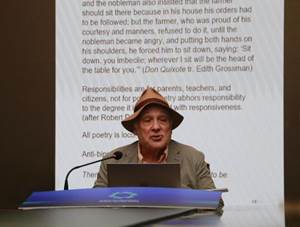
Prof. Bernstein’s lecture sparked lively discussion. Professor FANG Fan praised its poetic theme and reflected on the role of reader participation and understanding in the generation of poetic meaning. She noted that cross‑lingual reading is challenging due to cultural differences but holds great potential for fostering cross‑cultural thinking. Researcher Will Greenshields raised the question of the ideal reader. Prof. Bernstein replied that, given poetry’s openness, an ideal reader seeks connections and meanings within a poem’s elusive language and performs deep interpretation across cultural contexts. Student LIN Xiao, using Alfred Lord Tennyson as an example, discussed how a poet can convey meaningful messages without lapsing into didacticism and how to preserve a poem’s artistic integrity without sacrificing audiences’ appreciation of its intrinsic value. Another student ZHU Qiaorui observed a pluralizing turn and “meta‑poetic” reflection in Bernstein’s own work. Prof. Bernstein added that the key to integrating such wide‑ranging themes into craft lies in elusive expression, the use of blank space, and the drive to articulate poetry’s essence through poetic form.
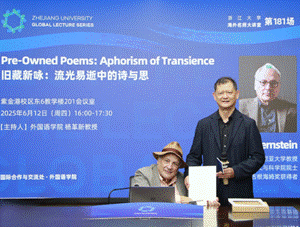
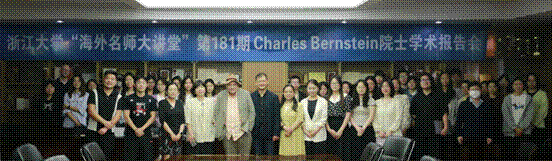
In his closing remarks, Professor YANG Gexin emphasized that in the age of artificial intelligence, poetry, as a distinctive expression of the human spirit, gains even greater importance. Poetry not only carries rich emotions and ideas but also prompts humans to reexamine their unique value and return to reflection on the essence of life. Amid rapid technological change, poetry provides emotional depth and intellectual warmth, helping us recover the temperature of the heart and serving as an essential bond for human emotional connection and expressive thought. Prof. YANG stressed that poetry is not only a symbol of culture and feeling but also carries future insights and enduring questions of the human spirit. As technology advances, poetry offers modern society a force against mechanization and virtualization and is indispensable nourishment for the human spirit. Finally, Prof. YANG presented Prof. Bernstein with a certificate of appreciation from the Global Lecture Series.
Professor Bernstein’s visit not only deepened international cooperation between the two universities but also provided students and teachers with a valuable platform for academic exchange. It further promoted cross‑cultural scholarly dialogue and intellectual exchanges.
Institute for Interdisciplinary Study of World Literature, Zhejiang University
June 12, 2025
Translated by WANG Jingyun, Proofread by XU Xueying

