
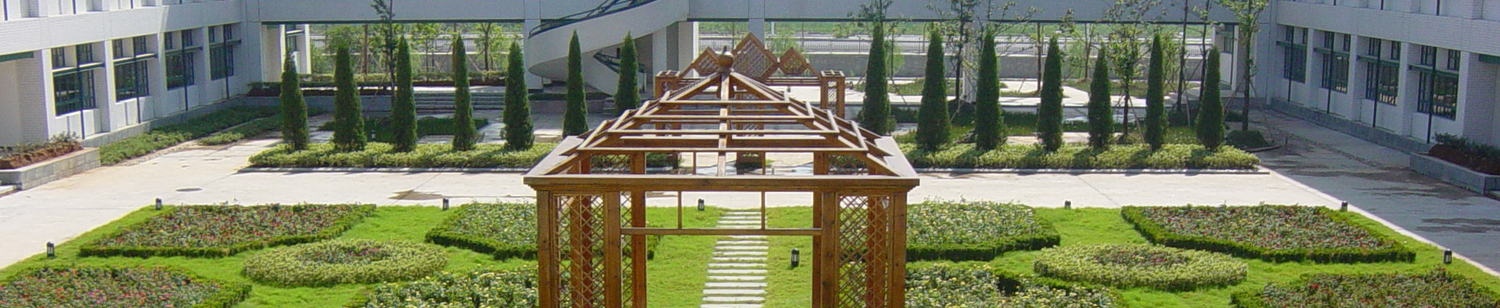
From October 18 to 21, 2025, the 46th International Colloquium of Functional Linguistics and the Symposium on the French Translation of Tang Lan’s Chinese Philology were successfully convened at Zhejiang University. The event was jointly organized by the International Society for Functional Linguistics (SILF), the Chinese Academy of Translation and Translation Studies of Zhejiang University, and the Institute of French Language and Culture of the School of International Studies. This colloquium represents a significant milestone as the first major international academic conference within the SILF to be organized by the fourth generation of functional linguistics scholars. It also carries profound academic significance for it marks the entry of functional linguistics research into a new stage of development in the contemporary era.
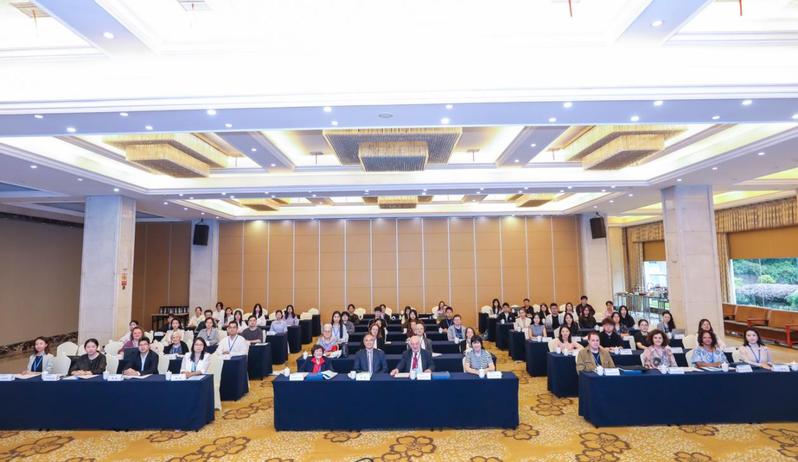
Group Photo of the 46th International Colloquium of Functional Linguistics
This colloquium marks a new beginning of academic dialogue in international functional linguistics. Established in 1976, the SILF serves as a vital platform for advancing functional linguistics research and cross‑linguistic studies. The decision to hold this year’s colloquium at Zhejiang University reflects the growing importance of research on the Chinese language and China’s minority languages in international linguistics. With the rapid development of studies in language policy, cross‑lingual communication, and language contact typology, Chinese language corpora and Eastern writing traditions are increasingly becoming new empirical sources and theoretical drivers for functional linguistics.
On the morning of 18th, the colloquium officially commenced at the Conference Center of North China Hotel (West Lake), adjacent to Zhejiang University’s Yuquan Campus. The opening ceremony was hosted by Associate Professor SHI Yeting, Deputy Director of the Institute of French Language and Culture, the School of International Studies.
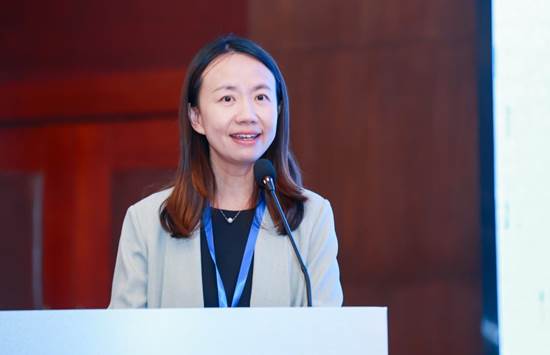
Associate Professor SHI Yeting Presiding Over the Opening Ceremony
At the opening ceremony, Professor XU Jun, Senior Professor of Humanities, and Director of the Chinese Academy of Translation and Translation Studies of Zhejiang University, delivered the opening address. In his speech, he noted that functional linguistics shares profound historical ties with Chinese academia. As early as over sixty years ago, the functionalist framework established by André Martinet was introduced to China, while the translation theories of Georges Mounin are resonating widely in China too. He emphasized that this colloquium in Hangzhou is both a continuation of academic exchanges and “a beautiful convergence of scientific spirit and humanistic vision”.
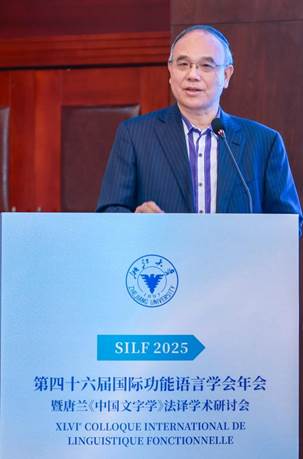
Professor XU Jun Delivering the Opening Address
Professor ZHAO Jia, Director of the Institute of French Language and Culture, the School of International Studies of Zhejiang University, reviewed the long-standing cooperative ties between Zhejiang University and several prestigious French institutions. She highlighted the French program at Zhejiang University as a key force in Sino-French educational and research collaboration.
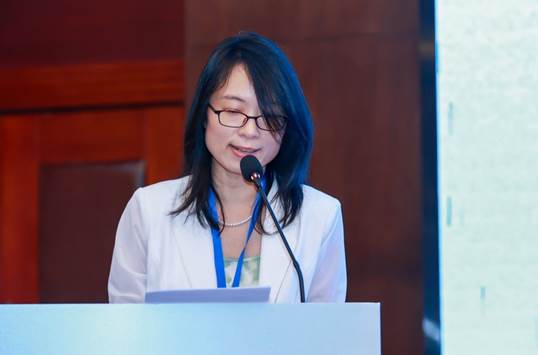
Professor ZHAO Jia Addressing the Colloquium
Professor Henriette Walter, President of the SILF, expressed sincere gratitude to Zhejiang University as the host institution. The 96-year-old scholar underscored the three core themes of the colloquium: translation studies, language policy, and language description, in particular, the new challenges and opportunities from the rapid development of AI in translation and linguistics.
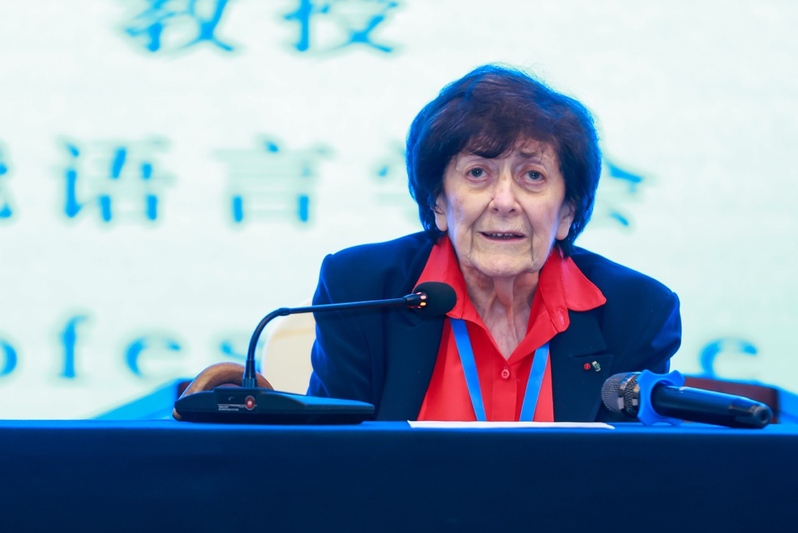
Professor Henriette Walter Addressing the Conference
Professor Christos Clairis, Vice President of the SILF, reviewed in his address the four generations of academic lineage in functional linguistics since its founder, André Martinet. He stated that this conference signifies the formal presence of the fourth generation of functional linguists onto the international academic arena. Professor Clairis highlighted that functional linguistics has stayed fast to the principle of “double articulation” as its core theoretical framework, in particular on the dynamic nature and diversity of language, so it is a foundational pillar of modern linguistics.
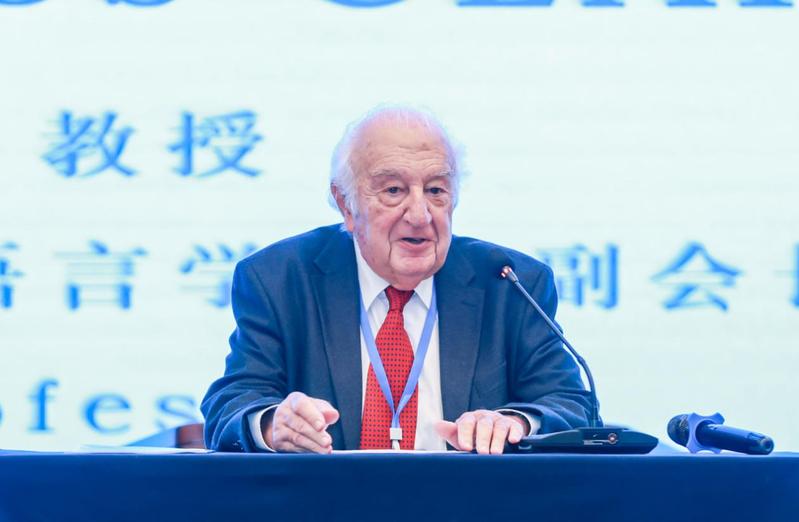
Professor Christos Clairis Addressing the Conference
After the opening ceremony, over seventy scholars from China, France, Greece, Qatar, Spain, and other countries engaged in the academic dialogue under three themes: “Translation and Translation Studies”, “Language Policy” and “Language Description and Diversity”.
The “Translation and Translation Studies” section comprised four panel discussions, moderated respectively by Professor Dimitra Delli of the University of the Peloponnese (Greece), Professor Aziza Boucherit of Université Paris Cité, Professor SHAO Bin of Zhejiang University, and Researcher YU Mengyang of Zhejiang University. Scholars went beyond traditional boundaries of linguistic research in their studies. Professor Henriette Walter, President of the SILF, introduced a pioneering hierarchical analysis theory for “false-friend” vocabulary, offering a new analytical framework for cross-linguistic understanding. Meanwhile, experts including Professor ZHONGYING Lunpa, Associate Professor Maria Tsigou, Researcher Elena Berthemet, and Associate Professor LI Wenrui explored frontier issues such as linguistic equity in the era of AI translation, mechanisms for translating culture-loaded terms across languages, and strategies for metaphor translation in political discourse.
The four discussions under the theme “Language Policy” were moderated respectively by Professor José Carlos Herreras of Université Paris Cité, Professor Hassan Hamzé of the Doha Institute for Graduate Studies, Associate Professor Maria Tsigou of the Ionian University (Greece), and Dr. WANG Ning, a young faculty member of Beijing Foreign Studies University. The discussions addressed the challenges of language governance in a globalized era. Scholars such as Professor Nizha Chatar-Moumni, Associate Professor ZHANG Fang, Dr. LI Mengyu, and Dr. WU Jingyao compared the demands for official recognition of regional languages in the European Union with practical efforts in China to protect linguistic ecology, examined issues of Arabic language standardization, analyzed strategies for maintaining the status of French in the digital age, and investigated the linguistic landscape of Sanya, Hainan as an international tourist destination. The studies provided fresh perspectives for building governance systems for multilingual societies.
Under the research theme “Language Description and Diversity”, four sessions were chaired respectively by Professor Nizha Chatar-Moumni of Université Paris Cité, Professor Christos Clairis of Université Paris Cité, Associate Professor Françoise Guérin of Sorbonne Université, and Associate Professor Béatrice Jeannot-Fourcaud of Université des Antilles. The participating scholars showed the strengths of the functional linguistic methodology. Scholars such as Professor Dimitra Delli, Dr. WANG Xiaoxi, and Tenure-track Associate Professor ZONG Meng delivered in-depth presentations on multilingual materials. Their reports covered topics from synchronic variation in Chinese dialects to the morphological structures of African languages, from the fusion of ancient Greek dialects to the preservation of minority languages, and from language contact to diachronic language change. The rich linguistic data, complemented by rigorous functional analysis, provided detailed descriptions and analyses for the better understanding of the structural diversity and operational mechanisms of human languages.
During the conference, the roundtable forum “Symposium on the French Translation of Tang Lan’s Chinese Philology” was held, serving as a key component of this year’s annual conference in promoting the global dissemination of Chinese academic excellence. This high-level dialogue brought together distinguished scholars from both China and France to engage in in-depth discussions on crucial issues such as translation strategies for classic Chinese philological works, the construction of terminological systems, and pathways for global dissemination. The scholars reached consensus on specific initiatives, e.g., establishing a Sino-French academic terminology system for philology, standardizing classical text citations, and building digital platforms, while also exploring collaboration in related fields.
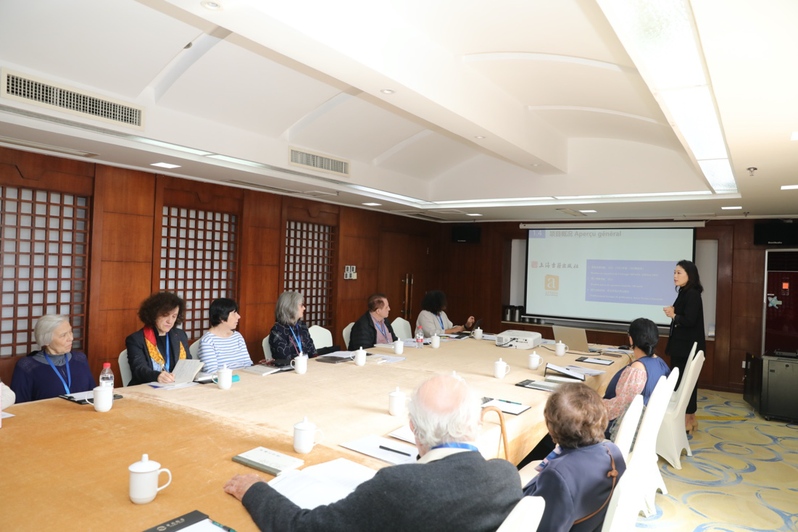
Symposium on the French Translation of Tang Lan’s “Chinese Philology”
During the annual meeting, the SILF convened its General Assembly. Through a vote by delegates, Researcher YU Mengyang, a young scholar from Zhejiang University, was elected as a Standing Council Member of the SILF.
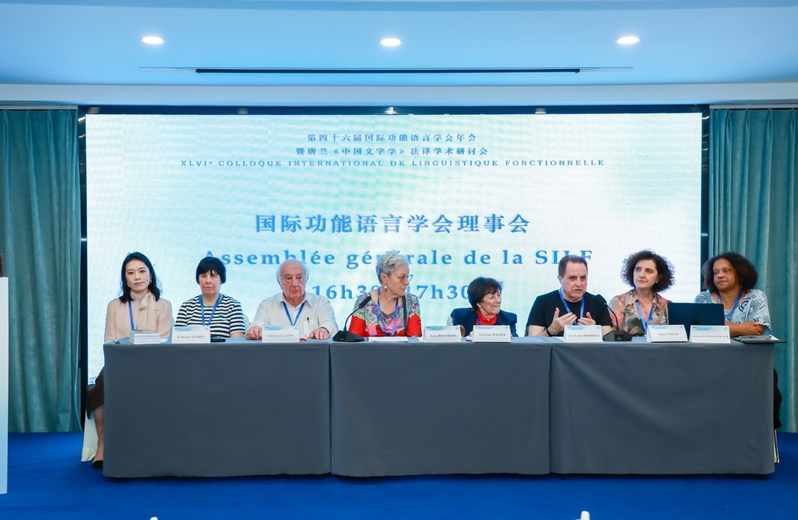
Group Photo of the Standing Director of the International Society for Functional Linguistics and the Session Moderator
The success of this year’s annual conference has yielded multiple impacts. Firstly, it has contributed to building a high-level platform for international academic dialogue, promoting the integration of Chinese linguistics studies into mainstream international academic discourse, and facilitating theoretical innovation and methodological renewal. Meanwhile, using linguistics as a link, it deepens mutual learning among civilizations and the sharing of knowledge, opening new pathways for building a more equitable and diverse global academic ecosystem. More importantly, through in-depth exchanges with world-leading scholars, early-career researchers have not only broadened their academic horizons but also boosted their theoretical confidence, injecting new momentum into the sustainable development of the discipline.
Translated by YU Jinbo, Proofread by XU Xueying

