

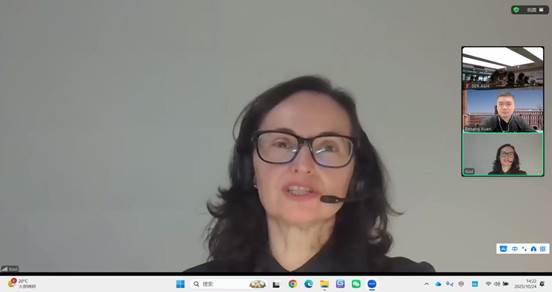
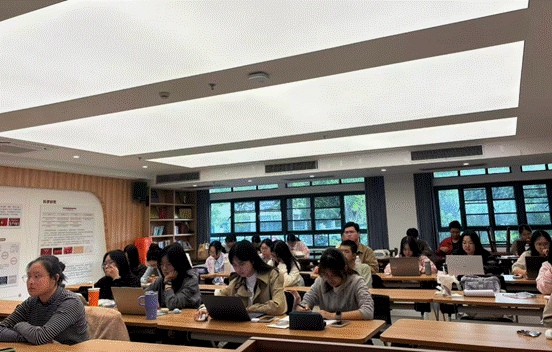
To deepen training of law professionals working with foreign affairs and enhance the professional competence and international competitiveness of interdisciplinary legal talents in the digital era, the Dong’s Academic Salon in Literature, History and Philosophy at Zhejiang University and the double bachelor’s degree program in English & Law major organized a lecture titled “Legal Translation in the Digital Age” on the afternoon of October 24 in Room E102, School of International Studies. The lecture invited Prof. Łucja Biel, a Scholar on International Legal Translation Studies from the University of Warsaw as the keynote speaker to offer English‑major undergraduates and other students and teachers interested in legal translation a lecture with cutting‑edge insights, practical utility, and global perspective. Prof. Qu Wensheng, a renowned scholar on legal translation and translation‑history, Qiushi Distinguished Professor and Dean of the School of International Studies at Zhejiang University, served as commentator, and ZJU 100 Young Professor Xuan Ben’ang served as moderator.
In her lecture, Prof. Biel systematically examined the profound changes that digital technologies have brought to legal translation, reviewing the current applications and challenges of artificial intelligence, machine translation, and natural language processing in translating legal texts. Comparing terminology in English and Polish, she stated that “With increasingly frequent cross‑border legal cooperation, legal translation is not merely language conversion but a depth‑laden practice involving legal systems, cultural contexts, and technical tools, so translators are expected to hold multi‑system perspectives and technical sensitivity”.
Prof. Biel noted that legal translation is a high‑end niche market within the translation industry. It must combine the creativity of literary translation with the terminological precision of technical translation, which entails careful management of information‑transfer risks. Drawing on extensive project experience, she analyzed the precision of legal terminology, the legal force of texts, as well as ethical considerations and accountability in machine‑assisted translation. She emphasized that as automation tools get popular, translators’ strategic professional abilities and tool competence have moved from peripheral concerns to central imperatives.
Professor QU Wensheng provided comments on the lecture and engaged Prof. Biel in an in‑depth exchange on common issues in legal translation research. Based on his research in legal‑history translation, Prof. QU argued that legal translation must be anchored in specific historical and social contexts. He also discussed with Prof. Biel approaches to addressing uniformity challenges in legal translation research and practice across EU countries arising from national and linguistic differences.
An interactive Q&A followed. Students and teachers discussed issues such as accuracy vs. equivalence in legal translation, procedural difficulties in international legal communication, and the challenges faced by legal translation in the AI era. Prof. Biel answered patiently and encouraged students to embrace technological change while upholding the rigor and professionalism of legal translation with an open mindset for the new era.
The lecture was substantive with vivid cases and lively interaction. Attendees gained a lot in understanding legal translation and practical ability. One student commented, “Prof. Łucja Biel’s presentation broadened our international horizons and provided valuable guidance for building our ‘law, language, and technology’ competence”.
This lecture was not only a transmission of knowledge but also an intellectual inspiration and orientation guide. Its far‑reaching significance lies in illuminating a rational and mission‑driven path for law and language learners amid technological transformation. It also injects new momentum into Zhejiang University’s cultivation of interdisciplinary talents in foreign‑related law studies.
Text/Photos: ZHOU Haokai
Reviewed by: XUAN Ben’ang
Translated by WANG Jingyun, proofread by XU Xueying

