
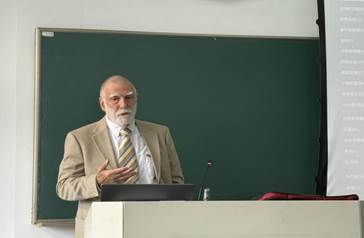
On October 21, a lecture by Dr. John Rosenwald (Ph.D., Duke University), Professor of English at Beloit College, titled “Approaches to Writing in an Academic Environment: An Abstract”, was successfully held on Zijingang Campus, Zhejiang University. Ann Arbor, a member of the editorial board of Beloit Poetry Journal, and Professor YIN Qiping of Hangzhou Normal University served as commentators. The lecture was moderated by Associate Professor SUN Yanping from the School of International Studies. Master and doctoral students from the School were also present.
At the start, Professor Rosenwald spoke from his own academic background and experience and outlined the standards of scholarly research. He recounted his doctoral studies at Duke University, where he conducted in‑depth research on William Morris under the mentorship of Lionel Stevenson. He described a shift in the U.S. academic environment in the 1960s: literature curricula starting to focus both on historical study and textual analysis and on literary creation as well. In response, Rosenwald turned his research toward the “mechanics of music” in poetry and extended his teaching to encompass both poetic analysis and composition. He stressed, however, that regardless of changes in the academic environment, scholars should adhere to four standards: carefully selecting research topics; attending closely to the historical trajectory of research questions; mastering the research methods appropriate to the topic; and establishing the contemporary value of the research.
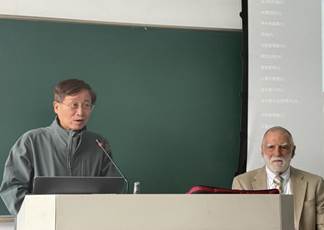
Professor YIN Qiping responded to Rosenwald’s remarks by elaborating on the concept of “taste” and its importance in scholarly work. As a friend of both Professor Rosenwald and editor Ann Arbor, Prof. YIN praised their scholarly contributions and dedication to education and affirmed Rosenwald’s four standards. He then addressed the common “topic‑selection anxiety” among graduate students and invited students to share methods for identifying research problems. PhD candidates JI Zheng’ao and CHEN Boyang, drawing on their research experience, argued that new arguments should emerge from extensive reading of prior scholarship. Yin endorsed their scholarly approach and added that research questions should balance academic and non‑academic considerations: clarifying one’s research interests and reflecting on the work’s value to the world. He emphasized that research must link professional expertise with public discourse and that academic pursuit requires a cultivated sense of taste. Moreover, “taste” enables scholars to perceive the “beauty” within a field and to grasp the importance and value of their discipline. It fosters a panoramic perspective, facilitating multidimensional approaches to knowledge and higher‑level scrutiny of established connections. Graduate students should master their own field while understanding neighboring disciplines, thus situating their subject within the broader knowledge system to cultivate taste. Furthermore, “taste” entails discernment and aesthetic judgment, key capacities for assessing a project’s value, especially in selecting primary and secondary sources. On this point, PhD student LIN Xiao observed that primary materials can spark research interest and reveal a discipline’s beauty. Prof. YIN affirmed the importance of primary sources while noting that “in some cases secondary materials are even more important”.
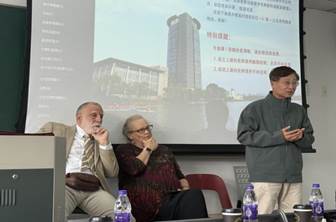
During the discussion, the three speakers encouraged students to raise questions about academic research and writing and responded to them. Master student MA Yifan expressed anxiety about overlapping with prior work and a lack of originality. Ann Arbor responded with a vivid anecdote: her poet friend Henry often feels his ideas have all been written before, yet in each reading he produces poems with distinct voices. The editor thereby stressed the importance of personal perspectives and expressions. Ann Arbor encouraged students not to fear repetition but to pose new questions from present‑day viewpoints. Another student ZHOU Xinjie asked about musicality in literature and the interpretation of related terminology in research. Professor Rosenwald cited stylistic differences among William Faulkner, Ernest Hemingway, and Virginia Woolf to show how musicality is deeply tied to a writer’s thought and modes of expression. Mrs. Arbor pointed to Margaret Atwood, a Canadian writer, whose novels often retain the lyricism of poetry, to argue that the forms that carry musicality change with era and authorial identity, and encouraged attention to the dynamic relation of form and content. On terminology, Mr. Rosenwald advised building on prior research while proposing new understandings based on contemporary perspectives.
After the discussion, Mr. Rosenwald and Mrs. Arbor presented a poetry reading and musical performance that brought the event to a climax. They performed Robert Bly’s The Winter Ant. Their heartfelt recitation conveyed the beauty of literature to the audience. They noted the poem’s “carapace” as a symbol of how trauma causes people to hide their true selves, and said they hoped the reading would encourage students to express their authentic feelings. Following the recitation, the two guests performed classic American songs enthusiastically. Mrs. Arbor offered further words of encouragement, urging students to approach academic research and life with optimism and steady progress.
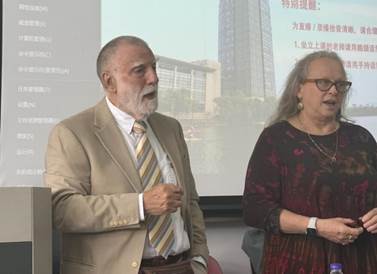
At the lecture’s close, Associate Professor SUN Yanping thanked the three scholars on behalf of students and teachers for the novel forms and memorable contents of event. Mrs. Arbor reiterated the importance of Sino‑American humanistic exchanges, observing that the academic work and sincere emotions of those present are gifts to the world.
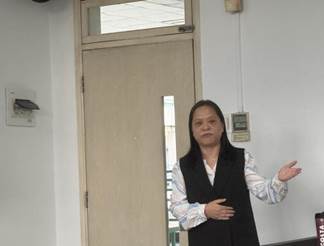
This interactive lecture addressed the core needs for graduate academic development. Drawing on their academic and life experiences, the scholars emphasized that research must balance academic value and humanistic care. They advocated cultivating an academic taste capable of discerning connections and maintaining a panoramic view of knowledge, while also rejecting utilitarian motives. Instead, researchers should pursue meaningful academic outcomes rooted in genuine interest. The session proved highly beneficial to all attendees and concluded amid warm applause.
Photos: CHEN Boyang
Text: CHEN Boyang
Institute of Foreign Literature, Zhejiang University
English Language & Literature, School of International Studies, Zhejiang University
Department of English Language & Literature, School of International Studies, Zhejiang University
Translated by WANG Jingyun, proofread by XU Xueying

