

On the morning of June 3, 2026, an academic lecture titled “Frequency and the Acquisition of Word Order” was delivered by Professor Anna Gavarró from the Department of Catalan Philology at the Autonomous University of Barcelona (Universitat Autònoma de Barcelona), Spain, and moderated by Professor ZHOU Peng from the School of International Studies (SIS), Zhejiang University, with active participation from students, teachers, and researchers in related fields from Zhejiang University and other universities.
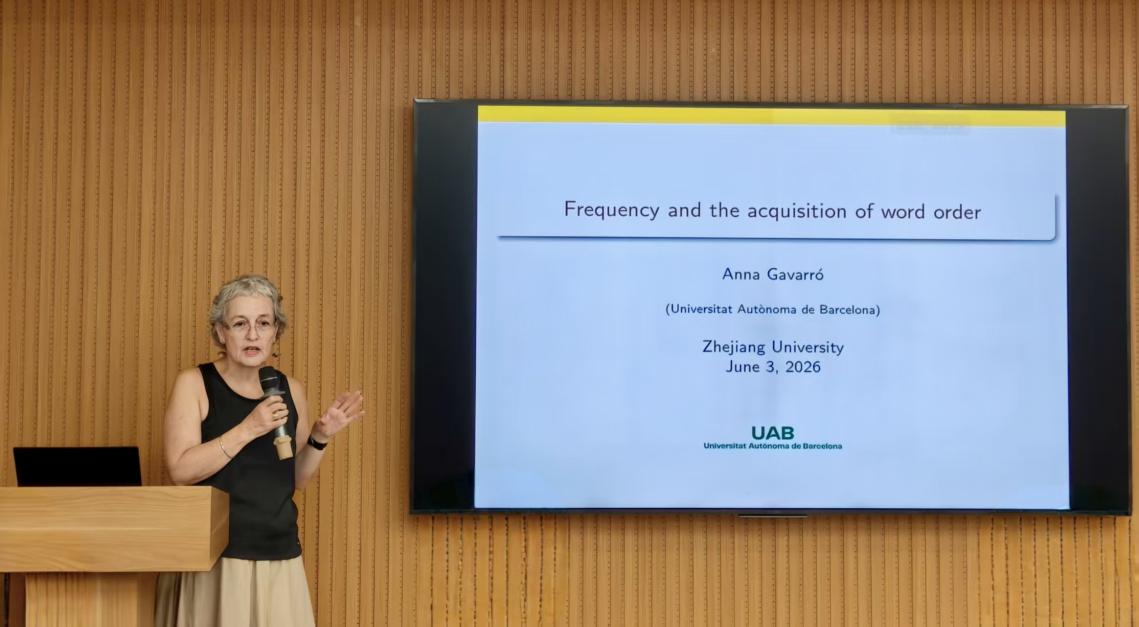
The lecture centered on whether language input frequency determines children’s mastery of word order and syntactic structures, which is a crucial question in the research of child language acquisition. Drawing upon a series of empirical studies conducted with her research team in recent years, Professor Gavarró introduced children’s capacity to comprehend different syntactic structures in the early stages of language development, and explored the role and limitations of frequency factors in the process of language acquisition.
During the lecture, starting from the core theory of “Very Early Parameter Setting (VEPS)”, Professor Gavarró discussed how infants master complex syntactic structures despite low-frequency language input. This theory asserts 18 months have already correctly set the basic grammatical parameters of their native language, such as verb movement and word order. To verify this, she later shared her team’s research on how infants with a mean age of 17 months comprehend atypical word order structures, such as the ba (把)construction. The study employed the preferential looking paradigm and included two experiments. Experiment I found that infants can still correctly comprehend atypical word order structures such as S+ba (把)+OV although the ba (把) construction has a lower frequency in language input. Experiment II revealed that infants in this age group had already correctly set the word order parameters in Chinese, and ruled out the possibility of their using an agent-first strategy. Based on these experimental findings, Professor Gavarró remarked that children are already capable of understanding some complex syntactic structures and demonstrating sensitivity to the word order of their native language even before their language output is fully mature.
Besides, Professor Gavarró presented follow-up research of her team on adult subjects. By comparing the comprehension mechanisms of adults and infants, the study found that adults rely heavily on contexts when processing atypical word orders, whereas infants are more sensitive to grammar and prosody. Moreover, based on evidence from Catalan-speaking infants, Professor Gavarró further elaborated on the universality of syntactic development. In conclusion, Professor Gavarró stated that these research findings strongly challenge usage-based theories of language acquisition and provide vital evidence for an innate grammatical framework for human linguistic capacity.
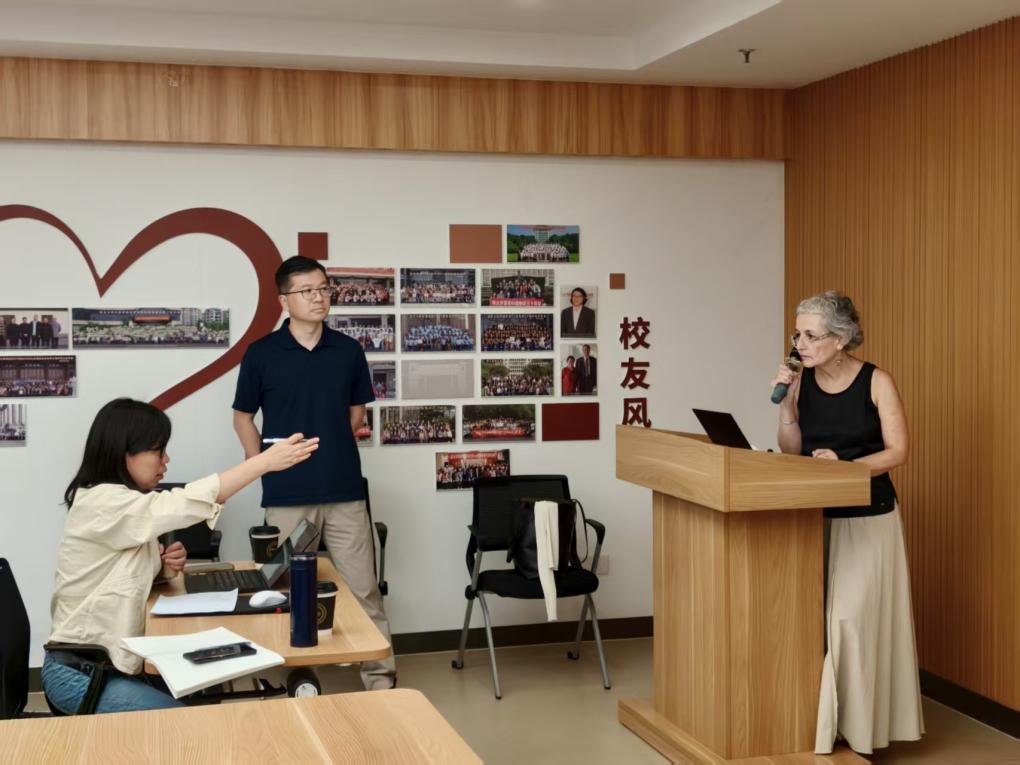
In closing, Professor Gavarró engaged in lively discussions with the students and teachers present, who raised questions of children’s syntactic development, experimental design, and explanations of language development by different theories. Based on her own experience, Professor Gavarró provided in-depth and detailed answers to these questions and shared the latest advancements in international frontier research.
This lecture showcased the latest research achievements in the field of child language acquisition, helping students and teachers better understand early child language development mechanisms. It also promoted academic exchanges between the SIS and international scholars, providing new inspiration and insights for related research.
Texts and Photos by YANG Yican
Reviewed by SHI Jiawei
Organized by Zijin Club
Translated by HONG Jiayao
Proofread by XU Xueying

