

On July 6, 2026, a workshop “Beyond Words: Computational Modeling in Modern Psycholinguistics and Human Communication” was delivered by Professor ZHANG Yang from the Department of Speech-Language-Hearing Sciences and Masonic Institute for the Developing Brain at the University of Minnesota, Twin Cities, USA, in the School of International Studies, Zhejiang University. Roughly 30 students and teachers from related research directions participated in the event.
With the rapid advancement of Machine Learning (ML), computational modeling is driving a paradigm shift in neurolinguistics and psycholinguistics, showing promising application in fields such as speech recognition, emotion recognition, and Large Language Models (LLMs). In the workshop, Professor ZHANG systematically presented the application of computational modeling in modern speech perception and language learning research. He elaborated how computational modeling helps researchers reveal language processing mechanisms from complex behavioral and neural data. Based on the latest research findings, he showcased the breakthrough progress made by integrating behavioral experiments, machine learning, and neuroscience in revealing the mechanisms of speech perception, language learning, and human communication, thereby providing new ideas for linguistic research empowered by AI.
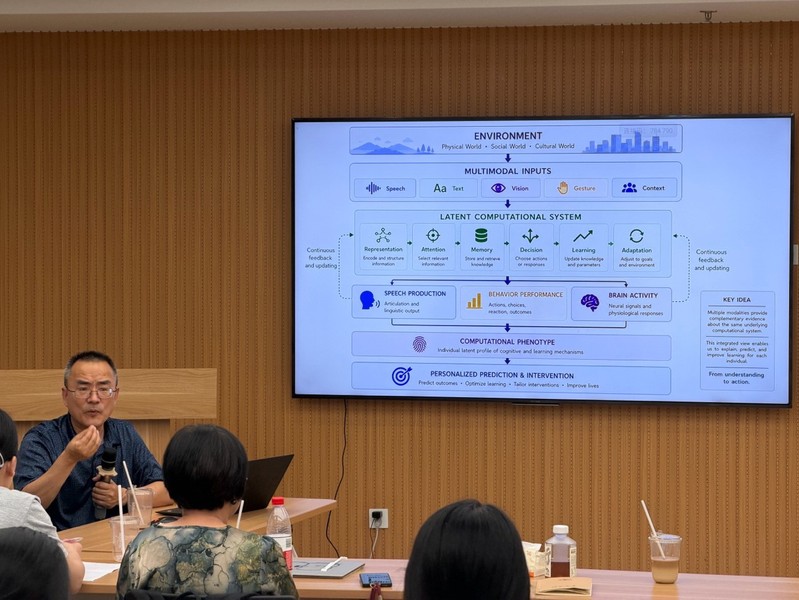

Centered on computational modeling methods for speech perception and learning, this training featured four modules to present the complete research path from behavioral analysis to neural modeling in this field. Module 1 was on the behavioral computational modeling of speech perception and production, introducing how to conduct computational analysis by using the R programming language combined with speech data, realizing the research process from speech signals to scientific discoveries. Module 2 centered on the Cue Reweighting mechanism in language learning, exploring how to construct mechanistic theories of language learning based on behavioral data. Module 3 presented computational analysis methods for EEG signals in speech and language research. Module 4 focused on the computational modeling of neural representations and its theoretical explanations, demonstrating the vital role of computational models in revealing the neural mechanisms of language cognition.
Based on his years of research experience, Professor ZHANG detailed the latest advancements of computational modeling in psycholinguistics, developmental science, and neurolinguistics. Through rich research cases, he presented a research paradigm that integrates behavioral experiments, EEG signal analysis, and machine learning models. The students and teachers present actively engaged in the in-depth discussions on issues such as the selection of computational modeling methods, model interpretability, and the application of AI technology in language research.

With frontier contents and rich cases, Professor ZHANG’s lecture showcased the latest progress in computational modeling for speech perception and learning research, and provided new research insights for students and teachers in the SIS to conduct interdisciplinary studies between AI and language science. The lecture is of great significance for the further understanding of the interaction between AI technology and human language cognition.
About the Speaker:
Professor ZHANG Yang is currently a professor in the Department of Speech-Language-Hearing Sciences and Masonic Institute for the Developing Brain at the University of Minnesota, Twin City, USA. He serves as a special issue editor for the journal Developmental Science and an associate editor for the Journal of Speech, Language, and Hearing Research. His main research interests include speech perception and production, developmental psychology, and the social, emotional, and cognitive foundations supporting neural consolidation and plasticity in the auditory and visual domains.
Language Cognition and Development Laboratory, SIS, ZJU
Science and Technology Ethics Committee, SIS, ZJU
Translated by HONG Jiayao
Proofread by XU Xueying

